By John Bengtson | 4 SEO Pros | Mesa, AZ
Let me be straight with you.
I’ve been doing SEO for over eight years. I’ve worked with enterprise clients at Gannett and Reach Local. I’ve built my own agency here in Phoenix. And right now, in May 2026, I get asked some version of this question almost every week:
“Is SEO even worth it anymore with all this AI stuff?”
It’s a fair question. Google looks completely different than it did two years ago. AI Overviews are everywhere. ChatGPT is answering questions that used to send people to your website. People are genuinely confused — and some of them are making bad decisions because of it.
So let’s talk about what’s actually happening. Real data. No fluff. No “SEO is fine, trust me” cheerleading. Just the truth.
The Hard Truth: Yes, Things Have Changed
I’m not going to sugarcoat it. The numbers are real and they matter.
Nearly two-thirds of all Google searches now end without a single click. According to research published in April 2026, the zero-click rate has climbed to 64.82% — up from around 50% back in 2019. That means the majority of people who type something into Google never visit a website at all. They get their answer right there on the results page and move on.
And AI Overviews are making this worse. When an AI Overview appears above your search results, the top organic result loses nearly one-fifth of its clicks — an 18% drop in click-through rate on average. For informational content — how-to articles, definitions, explainers — organic traffic is down 30 to 40 percent compared to a year ago.
One Ahrefs study analyzed 300,000 keywords and found that when an AI Overview is present, the position one result sees a 58% lower click-through rate. Fifty-eight percent. That’s not a rounding error. That’s a structural shift.
But Here’s What the “SEO Is Dead” Crowd Gets Wrong
Google still owns search. As of March 2026, Google holds roughly 90% of the global search market — about 82% on desktop and 95% on mobile. ChatGPT and Perplexity are growing, but they are not replacing Google. Not yet.
Organic search traffic didn’t vanish — it shifted. Search Engine Land’s reporting on 2026 data shows U.S. organic search traffic down about 2.5% year over year. That’s a real decline, but it’s not the apocalypse version of the story you see on LinkedIn.
The clicks that survive are worth more. Research from April 2026 shows that AI Overviews reduce organic CTR by 18% on average — but the clicks that do come through convert 23% better. And AI-referred traffic — people who click through from ChatGPT or Perplexity — converts 4.4 times better than standard organic search. Fewer clicks. Better visitors.
What’s Actually Happening to Search (Plain English Version)
Think of it this way. Google used to be a library where you had to walk to the shelf and grab the book yourself. Now there’s a librarian standing at the door who reads you a summary before you even get inside. Most people take the summary and leave. But the people who still walk in? They really want what’s in that library.
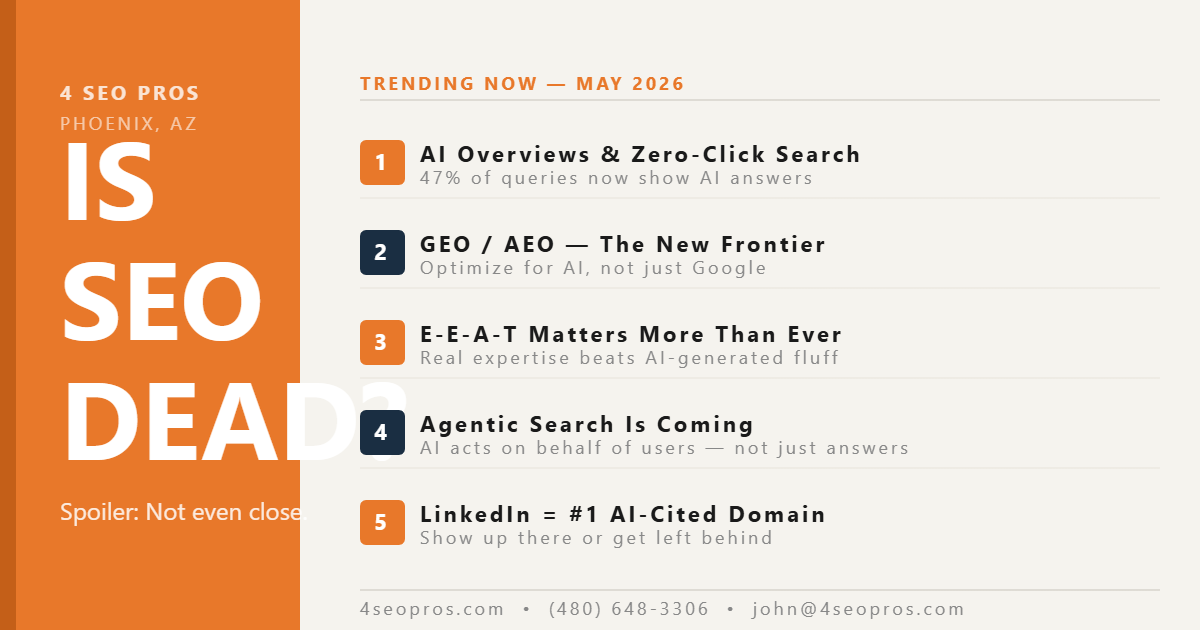
AI Overviews — Google’s AI-generated answer boxes now appear in roughly 13% of all queries, up from under 5% during the 2025 rollout. Expected to hit 20–25% by end of 2026. Ads now show inside AI Overviews in 25.5% of results.
Google AI Mode — Available to all U.S. users since May 2025. Runs dozens of sub-searches simultaneously using Gemini 2.5. Queries in AI Mode are 2–3x longer than traditional searches. Zero-click rate in AI Mode reaches 93%.
Agentic AI — AI systems that don’t just answer questions but act on them — finding your business, comparing you to competitors, making decisions on behalf of users. If your website can’t be read and processed by AI agents, you won’t exist in this new layer of search.
So What Do You Actually Do About It?
1. Stop chasing rankings as your only metric. Track impressions, AI Overview citations, branded search volume, and actual conversions — not just rankings.
2. Get cited in AI Overviews — that’s the new position 1. Being cited inside an AI Overview delivers 35% more organic clicks. Write content that is structured, authoritative, data-driven, and genuinely useful.
3. Build real E-E-A-T — not fake E-E-A-T. Author bios with real credentials. Case studies from actual client work. Data with sources cited. First-person experience. AI cannot replicate this for you.
4. Optimize for AI search engines, not just Google. GEO (Generative Engine Optimization) and AEO (Answer Engine Optimization) are real now. LinkedIn is the single most-cited domain across ChatGPT, Perplexity, Claude, and Gemini for professional queries.
5. Focus on transactional and local content. AI Overviews hit informational content hardest. Local searches are far less impacted. Your Google Business Profile and local citations are more valuable than ever.
6. Make your website useful, not just findable. Give visitors something they can’t get from a summary. Case studies. Real data. Your own opinions based on real experience. That’s what earns customers.
The Bottom Line
SEO is not dead. But the version that relied on keyword stuffing and waiting for rankings? That’s been dying for years — AI just accelerated the timeline.
What’s alive and thriving is SEO built on genuine expertise, real content, technical precision, and smart distribution across both traditional and AI-powered search channels. The businesses that adapt now have a real advantage.
I’ve been building tools to help businesses navigate exactly this shift. If you want to see what AI-powered SEO looks like in practice, check out ForgeSEO — the platform I built to bring these capabilities to agencies and businesses that can’t afford enterprise pricing.
Want to talk SEO/AI? Inbox open! -John | (480) 648-3306 | john@4seopros.com
Next up: How to Actually Get Cited in AI Overviews — A Step-by-Step Guide for Small Businesses.